Basel Institute joins regional effort to strengthen security, justice and development in Latin America
Reducing the economic power of organised crime is essential to improving security, strengthening justice systems and supporting sustainable development across Latin America and the Caribbean. And doing that requires strong and dependable partnerships.
Building on more than a decade of support to authorities across the region, the Basel Institute on Governance has formally joined the Alliance for Security, Justice and Development, a regional initiative led by the Inter-American Development Bank (IDB).
The Alliance seeks to strengthen coordinated responses to organised crime in Latin America and the Caribbean through dialogue, cooperation, knowledge exchange and resource mobilisation.
Supporting the fight against illicit financial flows
For the Basel Institute and its International Centre for Asset Recovery (ICAR), participation in the Alliance represents a further opportunity to contribute its expertise in financial investigations, asset recovery, international cooperation and public financial management while working alongside governments, international organisations and other partners committed to strengthening security, justice and development across the region.
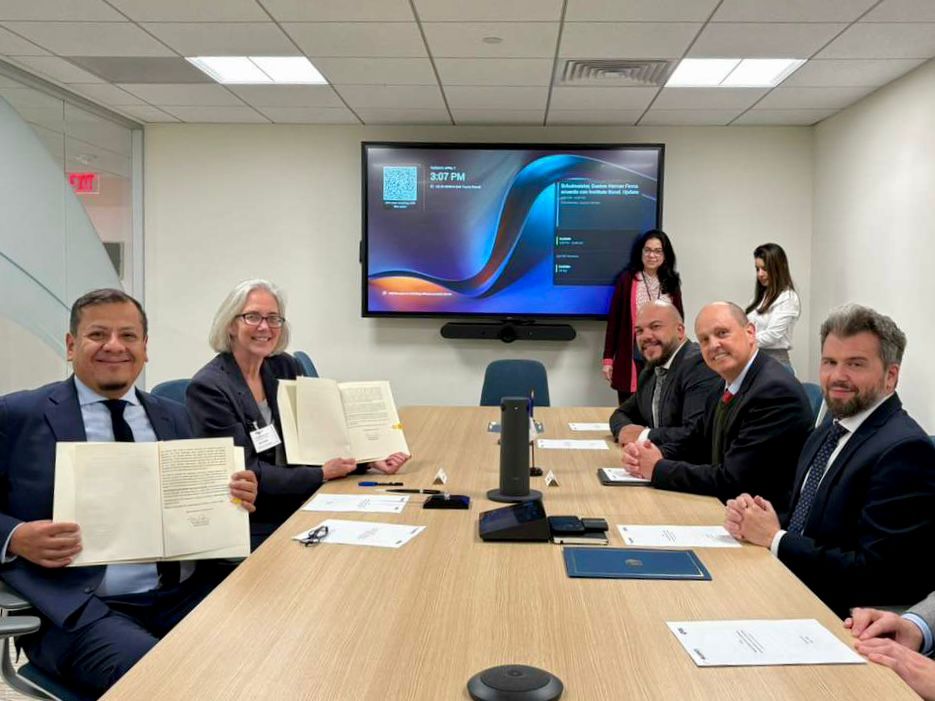
Executive Director Elizabeth Andersen signed the declaration formalising the Basel Institute’s participation in the Alliance in Washington, D.C.. The signing followed close engagement between senior IDB and Alliance representatives and Oscar Solórzano, Head of ICAR Latin America, together with Dennis Cheng.
Strengthening regional cooperation
The Alliance for Security, Justice and Development is a regional platform for dialogue, cooperation, knowledge exchange and resource mobilisation aimed at preventing and responding to organised crime in Latin America and the Caribbean.
Coordinated by the IDB through its Citizen Security Division, the Alliance currently brings together 23 member states and multiple strategic partners from the international, development and security sectors.
Its work is structured around three strategic pillars:
- protecting vulnerable communities from organised crime and violence;
- strengthening institutional resilience within security and justice systems; and
- reducing illicit financial flows and illicit markets to weaken the operational capacity and influence of criminal organisations.
Bringing expertise in asset recovery and financial investigations
The Basel Institute will contribute particularly to the third pillar, leaning on the expertise and two decades of experience of its specialised International Centre for Asset Recovery (ICAR).
Elizabeth Andersen stated that the Basel Institute is honoured to participate in such a high-level initiative focused on issues of critical importance for Latin America and the Caribbean, as well as for the broader international community.
Oscar Solórzano highlighted that the Alliance represents an important opportunity to support countries in strengthening asset recovery systems, international cooperation and institutional capacities against increasingly sophisticated forms of organised crime and illicit economies.
Building on a decade of support in Latin America
Our participation builds on more than a decade of operational and technical support to authorities across Latin America in areas including financial investigations, asset recovery, international cooperation and – through a dedicated programme – public financial management.
Activities under the Alliance framework are expected to begin in the region in the coming months, with our teams supporting key initiatives and technical workstreams developed through the Alliance in the years ahead.
Our participation reflects our longstanding commitment to helping countries tackle corruption, illicit financial flows and organised crime, and our belief that sustainable impact is achieved through strong partnerships that bring together public authorities, international organisations and practitioners around shared goals.