Professor Anne Peters on how anti-corruption organisations can survive in today’s volatile world
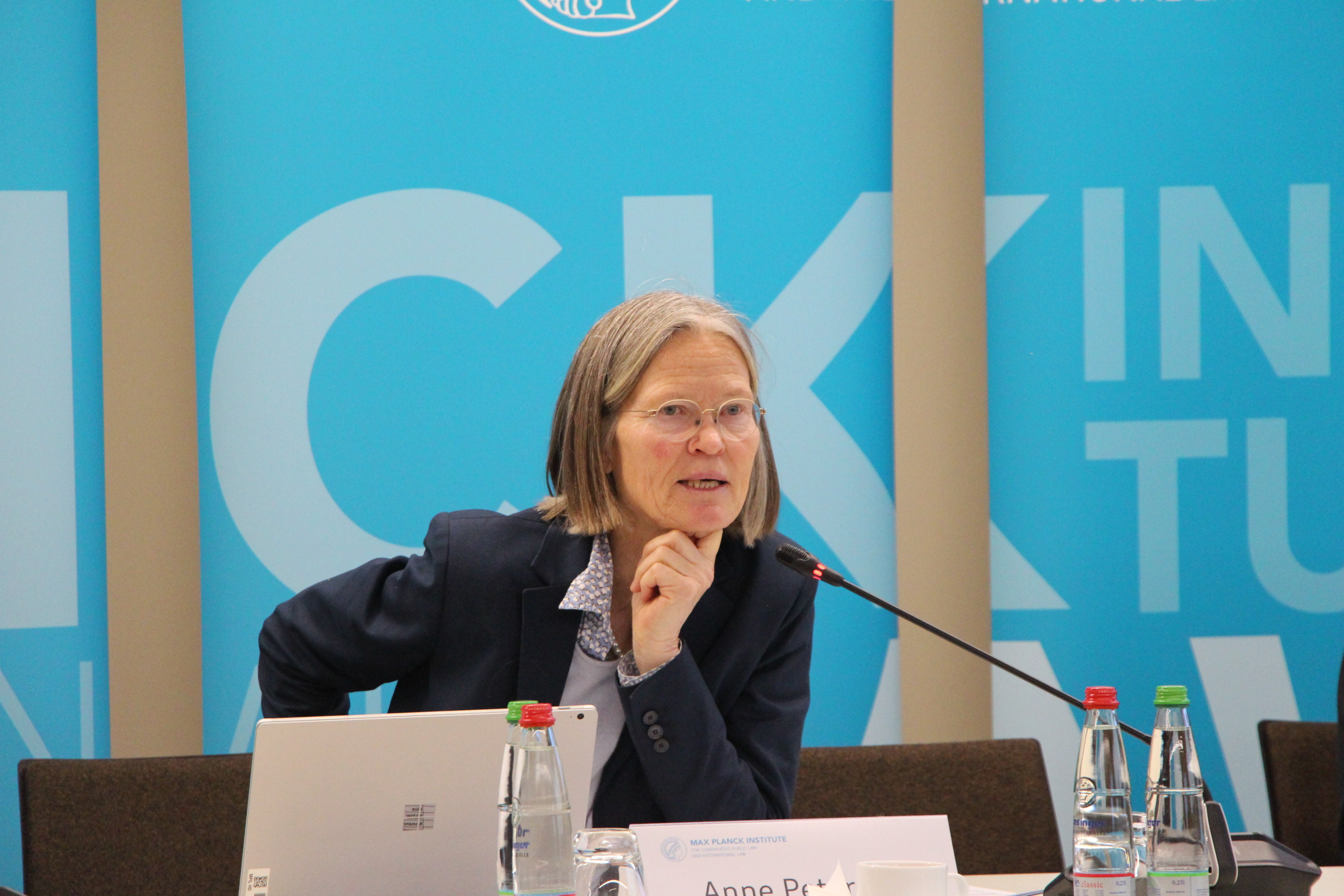
Professor Anne Peters, a renowned scholar of international law and governance, stepped down from her role as Vice President of the Basel Institute on Governance at the end of 2025. In this Q&A she looks back at her involvement with the Basel Institute since its inception more than 23 years ago.
Her insights emphasise the importance of underpinning anti-corruption and governance efforts with interdisciplinary academic research, and of connecting abstract concepts like governance and asset recovery to real-world challenges like human rights, biodiversity and climate change.
She traces the Basel Institute’s path from a small group of friends driven by individual passion to a highly professional, global centre of expertise on anti-corruption and asset recovery. This professionalism, she says, is essential for non-profit organisations to survive and even thrive in today’s unstable new world.
Anne is known for her pioneering work on animal rights, human rights and corruption. She holds long-standing academic positions as Director of the Max Planck Institute for Comparative Public Law and International Law (MPIL) Heidelberg and Professor of International Law at the University of Basel.
You were a part of the Basel Institute from the beginning. How did it all start?
My engagement with the Institute took root when I joined the University of Basel in 2001 and met Professor Mark Pieth, the Institute’s founder and former President. He was involved in establishing the Wolfsberg Group, an early multi-stakeholder initiative of banks focused on developing anti-money laundering guidelines. This was a time when concepts like banking due diligence and know-your-customer were relatively unknown, and the idea of multi-stakeholder associations didn’t even exist.
Because of Mark Pieth’s personal standing as a Professor of Criminal Law at the University of Basel and as Chair of the OECD Working Group on Bribery, he received requests for advisory and consultancy services on problems of corruption and governance.
The Basel Institute gradually rose out of those beginnings, helped by individuals like Gemma Aiolfi and Thomas Christ, who continued to play key roles at the Institute for the next two decades.
Back then we used to meet in cafés or in Mark’s office, and we just had a letterhead and a flyer describing the Basel Institute on Governance. Things became more formalised when we received seed funding from a foundation, drafted statutes and – this was the game-changer – hired Gretta Fenner in 2005. Gretta was the first paid staff member. We miss her dearly.
What excited you about it? What did you bring from the academic world?
I was young, I had energy and I liked Mark as a colleague and friend. The concept of governance was also quite new and exciting.
I am a public international lawyer, not a criminal lawyer, so I had little technical expertise in corruption or money laundering. But since these crimes have clear transnational dimensions, my background in international law made sense. I was able to bring the academic perspective to the Institute’s work, later reinforced by Lucy Koechlin and Claudia Baez Camargo, who joined to lead research on public and global governance.
The association with the University of Basel was crucial. It gave structure to the original idea: providing practical advice and assistance on corruption and governance, grounded in academic research. An important aspect was financing doctoral students who would work at the Basel Institute while completing their PhDs. I supervised three such dissertations.
This academic underpinning and insistence on research and evidence is still one of the Basel Institute’s strongest points.
What other milestones and innovations do you remember?
A major academic milestone was our conference on non-state actors and the resulting book, Non-State Actors as Standard Setters, which was published with Cambridge University Press in 2009. The term “non-state actor” – covering the private sector as well as non-profit organisations, academia, the media and the like – was still novel. I co-edited the book with Gretta Fenner, Lucy Koechlin and our former Board colleague and social anthropologist Till Förster. It was a serious and influential publication that is still cited today.
I remember us retreating for a full day to review drafts. At first the mix of different writing styles and perspectives – political science, law, social anthropology and sociology – was a bit of a shock. Then we realised the value of this interdisciplinary nature in helping to gain a holistic perspective of how non-state actors can contribute to setting governance standards in the messy world of real life.
Again, this interdisciplinary approach remains central to the Basel Institute’s current work.
How did the Basel Institute’s work expand into so many different areas – from asset recovery to conflicts of interest, to money laundering in the art market. What’s the connection?
Personal interests, reputations and networks mattered greatly. And new concepts were appearing in the international anti-corruption arena. People and governments needed help working out how to apply them in practice in different contexts.
That’s what happened with asset recovery, a concept that appeared in the 2003 UN Convention Against Corruption with the aim of depriving corrupt actors of their criminal gains. We developed a distinct workstream at the Basel Institute that soon became the International Centre for Asset Recovery.
The concept and practice of Collective Action – sustained, trust-based multi-stakeholder collaboration with the private sector to address specific corruption challenges – evolved in large part thanks to our colleague Gemma Aiolfi’s tireless efforts.
Similarly, it was a personal interest that led myself and fellow board member Lukas Handschin to edit a book on Conflict of Interest in Global, Public and Corporate Governance published by Cambridge University Press. It’s a topic that I was convinced was underappreciated at the time and is now, in these current times, showing its importance.
We did early work on money laundering in the art market. Again this was a personal interest of our board member Thomas Christ that is now a key concern for not only money laundering but sanctions evasion.
A newer area we have helped to establish internationally is green corruption, i.e. applying anti-corruption and governance tools to address challenges like the mass extinction of species, biodiversity decline, the climate crisis. This is a topic that is dear to me personally and that is evolving fast.
Common to this all is how the Basel Institute applies anti-corruption and governance research and tools to different fields that really matter in the world, from business to health to environmental protection.
And human rights? How does that connect to corruption?
My interest in the intersection between corruption and human rights grew from Gretta’s involvement in several side events at the UN Human Rights Council in Geneva. I began thinking about legal relationships between corruption and human rights and whether, for example, states have a human rights obligation to protect citizens from corruption.
I wrote a Working Paper on the topic for the Basel Institute back in 2015 and later published two academic papers. You can get a short overview of the topic in this Quick Guide to corruption and human rights.
The Office of the High Commissioner for Human Rights (UN Human Rights) references my work in a recently published practical guide on corruption and human rights to which I contributed, as well as other work of the Basel Institute on human rights in the context of asset recovery laws.
It’s great to see our scholarly work being used to underpin practical international guidance that will ultimately have impact on people’s lives.
What does the current global context mean for anti-corruption efforts and organisations like the Basel Institute?
We are in a period of profound global change. The political order is fundamentally shifting and the optimism of the 1990s is all but gone. The United States, an early driver of international anti-corruption treaties, efforts and successes, is retreating from its role. In some countries, anti-corruption laws and campaigns are misused for political purposes.
Even if concepts like good governance, rule of law, human rights and democracy don’t seem to be en vogue right now, they remain important. Not least because they, and corruption, are key to understanding and tackling today’s toughest challenges, from poverty and inequality to crime and conflict.
So non-profit organisations like the Basel Institute are more essential than ever, as are other non-state actors dedicated to tackling corruption and governance challenges. But it’s not easy for small organisations to survive in this rocky world, and many face their own governance challenges.
That’s why it’s good that the Basel Institute has professionalised its governance and compliance structures over the years, while keeping the sense of passion and personal conviction that characterised its early years.
Any bright side for those who care about anti-corruption and governance?
On the positive side, public awareness, opposition and global debate about corruption is far stronger than in the past. And much of international law – on travel, transportation, communication, diplomatic relations etc. – functions quietly and effectively every day.
Despite how dire the current situation seems, change for the better has only ever occurred after major catastrophes. For example, the establishment of the International Criminal Court in 1998 was a direct result of the rape camps and the Srebrenica massacre in Bosnia and Herzegovina.
The question is how severe crises must become and how much they must affect people directly before meaningful reform occurs. Climate change, biodiversity loss and pollution, for example, are slow-moving crises that still feel abstract to many.
What’s coming up for you personally?
In my research I remain focused on the big-picture development of the international legal order.
I look forward to the publication in 2026 of the Oxford Handbook of Global Animal Law, which I co-edited and which seeks to authoritatively establish this fairly new field of international law.
Alongside my research I continue to advise the German Foreign Affairs Department (and sometimes the Swiss, too), and will serve as an expert witness on international legal questions in a case before a domestic court.
And, of course I will continue to follow and support what the Basel Institute is doing. The organisation and its mission remain dear to my heart.
Thank you, Anne Peters, for your time and for your unwavering support and guidance over so many years. We wish you well in your future endeavours and adventures.