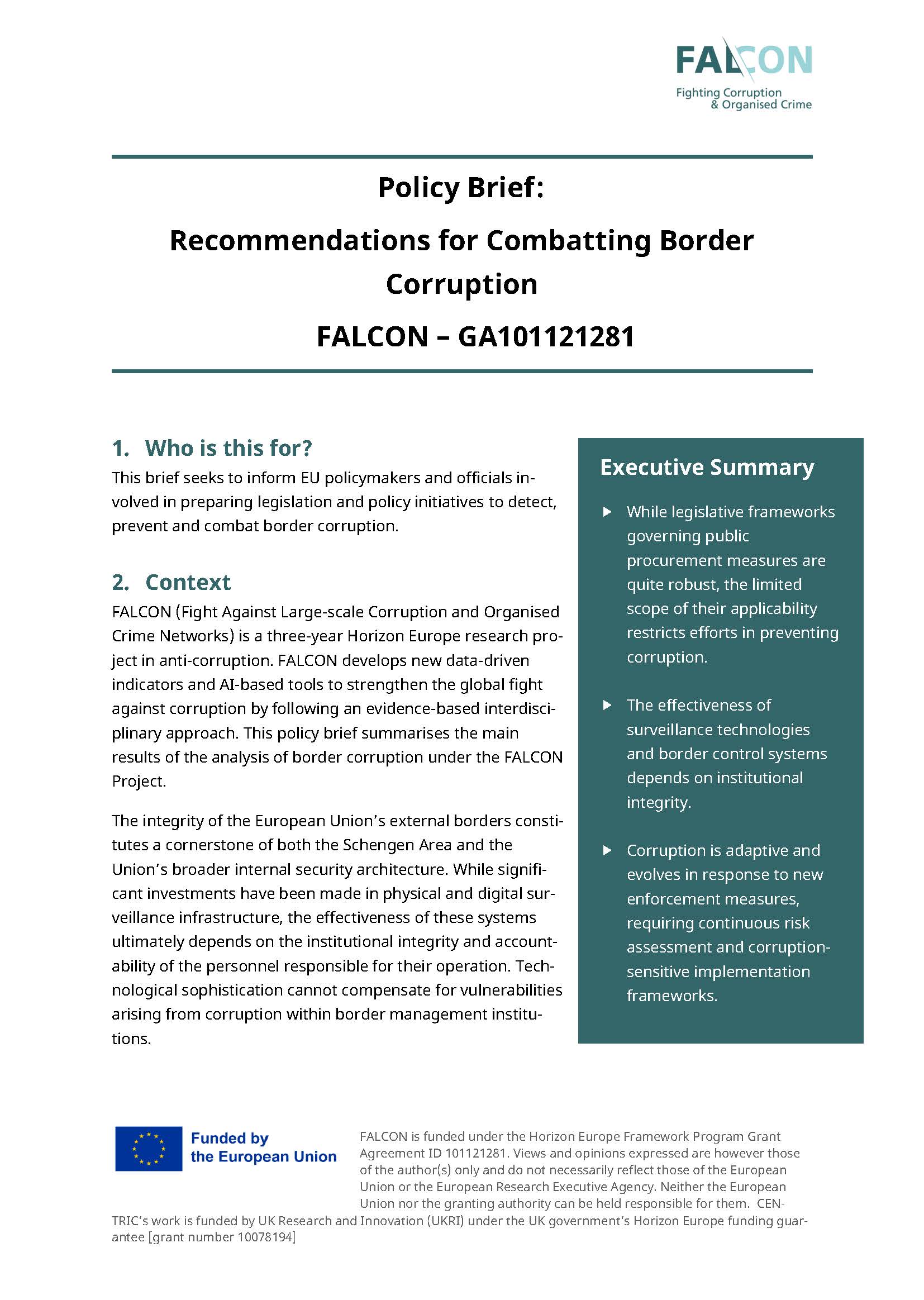
Recommendations for Combatting Border Corruption
Corruption at borders poses a significant threat to the integrity of the European Union’s external borders, undermining security, trust, and governance. And border corruption is not static — it evolves in response to new controls, technologies and enforcement strategies. This means that even well-designed measures may lose effectiveness over time.
A new Policy Brief by the FALCON (Fight Against Large-scale Corruption and Organised Crime Networks) project outlines actionable recommendations for EU policymakers and officials involved preventing and combatting border corruption.
The brief identifies four priority areas:
- reducing discretionary face-to-face interactions at border crossing points through digitalisation;
- developing harmonised, risk-based digital infrastructures that can detect corruption-prone patterns;
- limiting manual data handling to close opportunities for manipulation; and
- strengthening the conceptual alignment between anti-trafficking and anti-corruption strategies.
It argues that effective reform requires corruption-sensitive implementation frameworks, enhanced inter-agency coordination and a shift toward anticipatory governance.
The Basel Institute on Governance is an associated partner of the FALCON project. Jacopo Costa have contributed to the Policy Brief.
FALCON is funded under the Horizon Europe Framework Program Grant Agreement ID 101121281. The Basel Institute on Governance receives funding from the Swiss State Secretariat for Education, Research and Innovation (SERI).