The power of women as agents of anti-corruption: Q&A with SPAK Indonesia
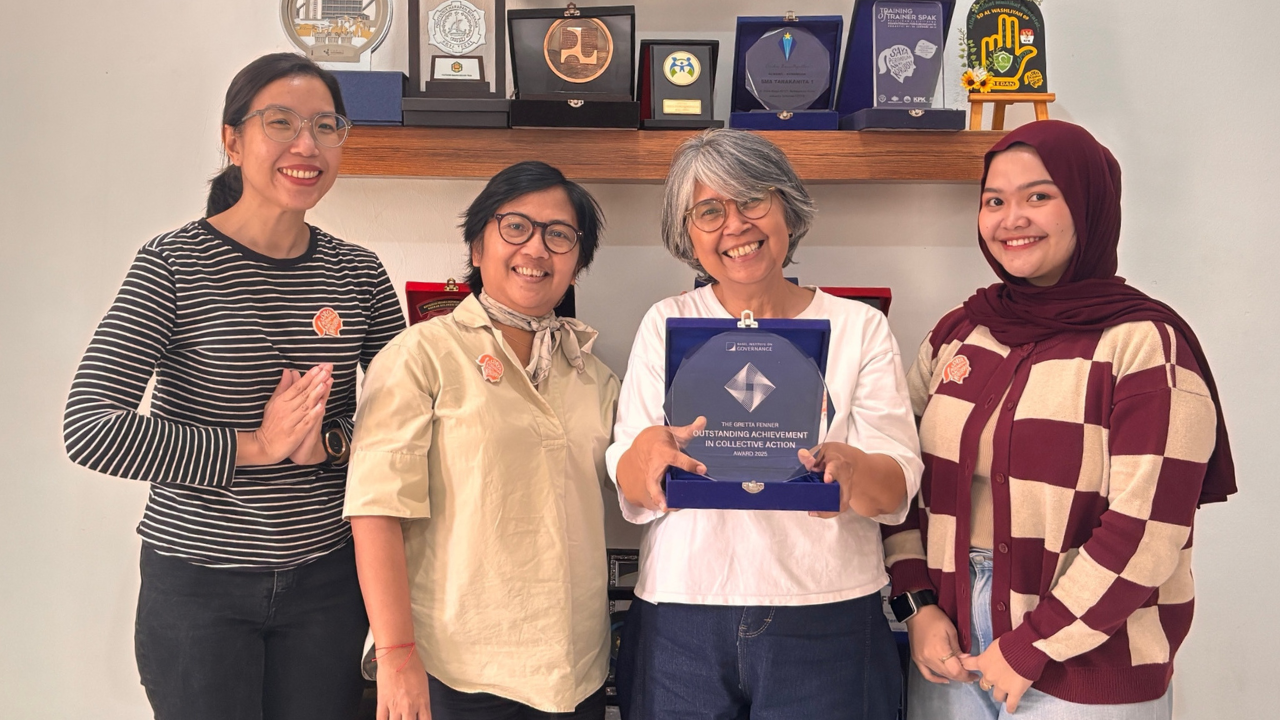
Women can play a crucial role in the fight against corruption. This is the conviction that underpins the work of SPAK Indonesia, the organisation awarded The Gretta Fenner Outstanding Achievement in Collective Action at the International Collective Action Awards 2025.
But why women, specifically? Because of their central role in transmitting moral and ethical values within their families and communities, shaping society from the inside.
Originated from the SPAK movement ("I am a Woman Against Corruption"), SPAK Indonesia has, for over a decade, systematised and built anti-corruption ecosystems through a network of “agents”: women from diverse backgrounds who promote integrity values across different private and public contexts.
The Outstanding Achievement in Collective Action award they received is a well-deserved recognition of their leadership, impact and innovation in corruption.
In this interview, Maria Kresentia, Director of SPAK Indonesia, reflects on how the organisation operates, the challenges it has encountered and the strategies that have enabled it to sustain this work.
SPAK is known for empowering women and communities to fight corruption through education and everyday actions. Can you briefly explain how your approach works in practice and what makes it effective?
Corruption is often viewed as something distant from oneself, as many people still believe that corruption is committed only by government officials. Addressing corruption is also often considered solely the responsibility of law enforcement authorities. SPAK takes a different approach by demonstrating that violations of moral and ethical values that become habitual are the starting point of larger corrupt practices.
Therefore, corruption becomes everyone’s concern, and its prevention can begin with each individual through the implementation of anti-corruption values in everyday life.
Women play a strategic role in promoting integrity and ethical behaviour. As primary caregivers, they are often the first to introduce moral and ethical values to the next generation.
In the Indonesian context, women also benefit from strong social participation and community access. These factors enable women to serve as effective agents in disseminating anti-corruption values at both household and community levels.
To facilitate this role, SPAK has developed anti-corruption learning tools in the form of board games designed for different age groups. This approach has proven effective in fostering behavioural change through women-led corruption prevention initiatives.
Your work relies strongly on collaboration between citizens, schools, civil society and public institutions. Why is Collective Action so important for fighting corruption in Indonesia?
All Indonesian citizens have a responsibility to combat corruption. Under the SPAK approach, awareness of moral and ethical values as the foundation of anti-corruption principles must be instilled in everyone, regardless of rank or authority.
While law enforcement remains important, building a society that is committed to anti-corruption values is equally critical to prevention efforts. This can only be achieved through coordinated actions among institutions and communities.
Looking back over the past years, what has been one of the biggest challenges SPAK has faced in building and maintaining this movement, and how did you overcome it?
One of the challenges is that prevention-oriented anti-corruption initiatives that centre on moral and ethical values are often underestimated and considered insufficiently newsworthy, causing stories of positive behavioural change to be overlooked by the media.
On the other hand, coverage of corrupt officials being arrested is generally viewed as more compelling than stories of teachers in remote elementary schools who refuse gifts from students in order to uphold the principle of fairness.
To address this challenge, SPAK consistently involves the media in its programmes, encouraging coverage that highlights how the application of anti-corruption values leads to meaningful change.
Securing funding support also remains challenging, as many institutions seek quick and measurable results. In response, SPAK proactively fosters collaboration with ministries, government bodies, local governments, the private sector and educational institutions to advance integrity-building efforts that are vital to strengthening Indonesia’s human capital.
Finally, mobilising young people to take part in corruption prevention efforts, starting with the cultivation of anti-corruption values, is challenging, as youth are often more interested in dramatic and confrontational actions such as demonstrations that may lead to violence.
To channel this energy constructively, SPAK facilitates online, inter-campus discussions on up-to-date issues, inviting respected and influential speakers.
By embedding anti-corruption values within these discussions, SPAK successfully engages students in meaningful dialogue while strengthening their understanding of integrity as a key solution to corruption.
What does winning the Outstanding Achievement in Collective Action Award mean for SPAK Indonesia and the women in your network who have been working on anti-corruption for over a decade?
Receiving this award is evidence that Indonesian women – regardless of their educational background or profession – are capable of building networks to drive change in the context of combating corruption.
After receiving this international recognition, what are SPAK’s main priorities for the next phase of your work, and how do you hope the award will support your future plans?
SPAK will remain committed to promoting anti-corruption values, which we consider essential in the fight against corruption in Indonesia. We seek to inspire more role models across government, private and educational institutions who are willing to lead change.
The awards we have received have strengthened our confidence that collaboration is the best way to build and expand an anti-corruption movement in society.
Thank you, Maria Kresentia for this enlightening conversation!
About the International Collective Action Awards
The International Collective Action Awards are awarded every year and acknowledge initiatives that showcase outstanding results, emerging best practices and innovation in the field of Collective Action to tackle corruption and raise standards of business integrity.
The Basel Institute on Governance, supported by an international jury of experts and a public vote, will present two Collective Action Awards at 6th International Collective Action Conference 2026.
- Outstanding Achievement in Collective Action: This award recognises organisations or initiatives that have made a significant contribution to fairer market conditions and the prevention of corruption through sustained and effective engagement in Collective Action.
- Collective Action Inspirational Newcomer: This award recognises organisations or initiatives that have been active in the field of Collective Action for less than two years and have shown strong potential to inspire others through their approach and early impact.
Nominations for the 2026 Awards are opened. For more information on the eligibility criteria, the selection process and the public vote, read the award methodology or visit the Collective Action website. The awards are presented with the support of the Siemens Integrity Initiative.