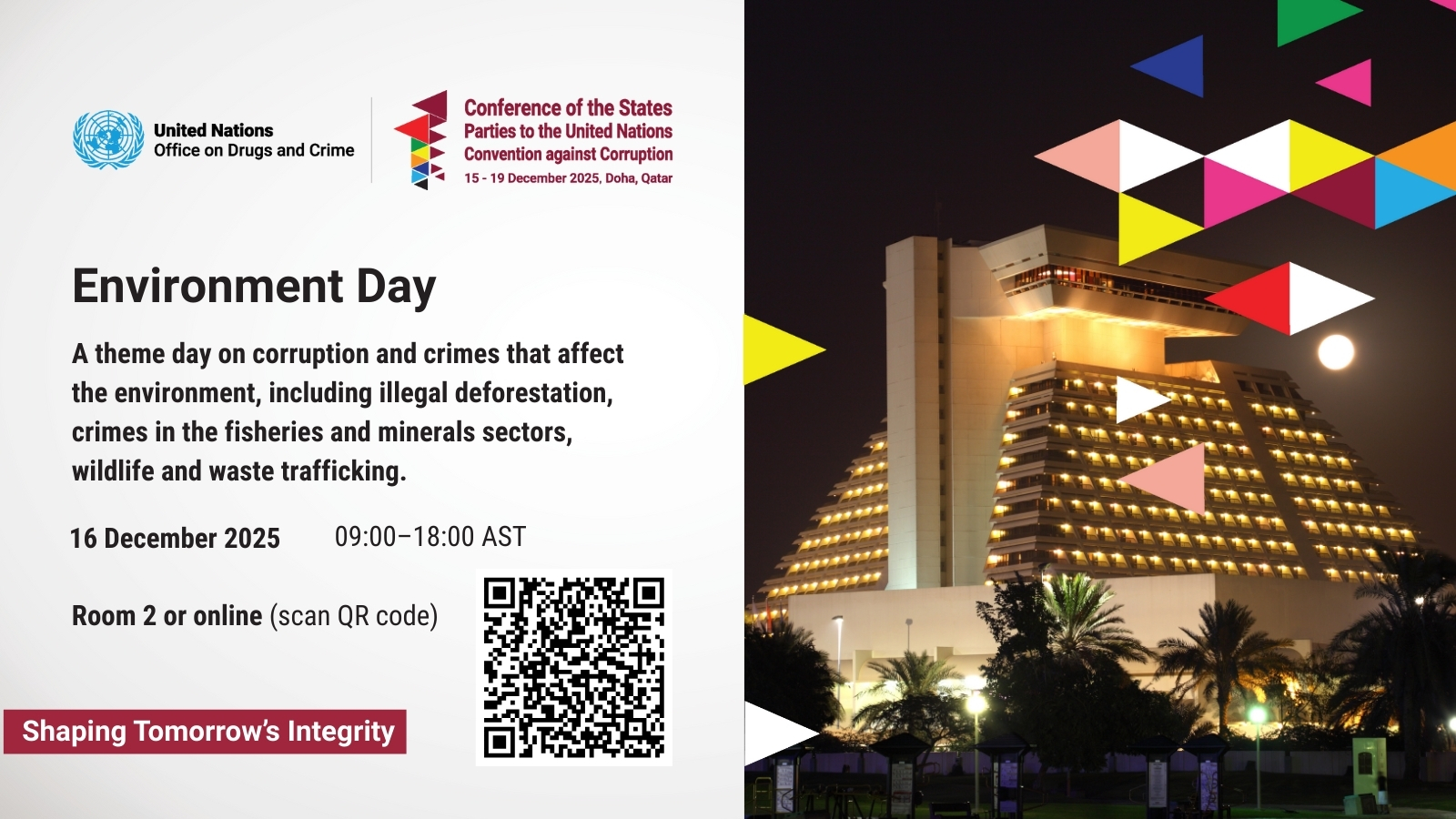
Environment Day at the 11th UN Conference of the States Parties to the UNCAC
Update: View all panel recordings on YouTube.
The Theme Day took place in a hybrid format at the 11th Conference of the States Parties to the UN Convention Against Corruption in Doha, Qatar. Corruption and crimes that affect the environment (illegal deforestation, crimes in the fisheries and minerals sectors, wildlife and waste trafficking, among others) are deeply intertwined and are mutually reinforcing.
Recognising this link, States Parties to the UN Convention Against Corruption (UNCAC) adopted Resolution 8/12. Why this Theme Day matters: This Theme Day brought together voices from the public and private sectors, civil society, academia and international organisations. Built on a shared belief in collaboration, the sessions explore how collective action and proven approaches can disrupt corruption and protect the environment, advancing a sustainable future.
What you will learn by watching the recordings
- Good practices and lessons learnt to disrupt corruption linked to crimes that affect the environment.
- Perspectives across sectors including insights, experiences and strategies.
- Key challenges and practical tools that can be mainstreamed to strengthen global efforts towards sustainability.
Environment Day was co-organised by a broad coalition of partners, including government institutions from Azerbaijan, Brazil, Colombia, France, Germany, Greece, Morocco, Namibia, Norway and Peru, alongside international and civil society organisations including the Basel Institute on Governance, GIZ, EITI, Fundación Ciudadanía y Desarrollo, Fundación Multitudes, the Green Climate Fund, the Global Civil Society Coalition for the UNCAC, HEDA Resource Centre, INTERPOL, the U4 Anti-Corruption Resource Centre, UNDP, UNODC, the Wildlife Justice Commission, the World Bank and WWF International.
Explore the playlist to hear directly from those shaping the fight against corruption and crime that affects the environment and discover practical pathways towards a more sustainable future.
Session overview
Session 1: Political finance transparency for a green transition
Corruption and abuse of political finance undermine climate and environmental goals. This event explores how transparent political finance and beneficial ownership can support green transitions and curb corruption. Recommendations for new UNCAC resolutions on these topics will be presented.
Session 2: Technology for integrity and environmental protection
Natural resources sustain economies and face growing threats from corruption and cross-border crime, driving climate, biodiversity, and pollution crises. This side event introduces innovative technology solutions to better prevent, detect, and address crimes that affect the environment.
Session 3: Corruption prevention in natural resource management
The session will discuss the building blocks of an effective governance framework to prevent corruption and environmental crimes and strengthen environmental and climate protection, highlighting real-life examples and the relevance of UNCAC, other global fora, and multi-stakeholder initiatives.
Session 4: High-level anti-corruption success stories for environment
This high-level session highlights achievements using anti-corruption measures to protect the planet, strengthen climate action, and manage natural resources. Participants will exchange lessons and explore strategies to scale effective approaches and accelerate impact.
Session 5: Accountability for corruption & crimes in the environment
This event will explore how stronger anti-corruption efforts under the UNCAC can help dismantle networks behind crimes affecting the environment. Speakers will share challenges, good practices, and tools to enhance enforcement, cooperation, and accountability for sustainability.
Session 6: Accountability pathways for climate action
Efficient climate finance requires exploring oversight and accountability tools. Panelists will discuss practical accountability mechanisms, challenges in prosecuting corrupt practices leading to environmental crime and monitoring climate funds, and strategies to counter corruption in this framework.
Session 7: Supranational collaboration for climate integrity
This panel will examine how international organisations, bilateral donors, and the private sector can collaborate to mitigate corruption risks in climate finance and promote transparency, accountability, and effectiveness in climate solutions. It will showcase best practices and identify emerging challenges.
Background reading
- Green Corruption programme at the Basel Institute on Governance and related publications